Showing posts with label lynching. Show all posts

Sunday, July 01, 2018

NY Times: 3 Black U.S. Senators Introduce Bill to Make Lynching a Federal Hate Crime

I was inches away from dismissing this as an empty gesture talking about there being more tangible issues to address as far as Black Americans. Now I can say, hmm it surprises me that the United States hadn't at any point in time been successfully been able to enact anti-lynching legislation.

I feel this will be a symbolic law unless the law addresses more modern issues. We believe in Black Lives Matter, perhaps use such a law to address any racially motivated police actions. Of course, keep the often feared mob from deciding to take justice in their own hands that often happened to many victims of lynching during the course of the 19th and 20th centuries.

Of course my impression of lynching had often been unfortunately racially motivated. Which is entirely why I could see this law as symbolic. Of course I'd be open to learning why having anti-lynching legislation is still very important now in the 21st century.

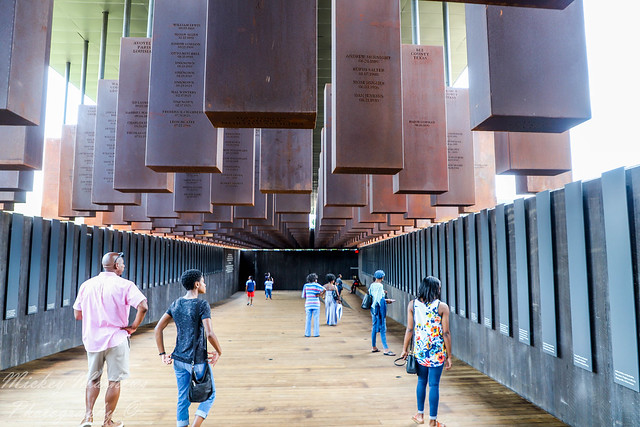
BTW, I'd be interested in this National Memorial for Peace & Justice in Montgomery, Alabama. This is the only memorial dedicated primarily for the victims of lynching in this nation.

Friday, December 14, 2007

The Noose…And It’s Role In Lynching Black Americans

Hermene Hartman the Publisher of the magapaper for the urbane, N'Digo has an editorial about the history of the noose and lynching. Better catch up to it quick because after the next week or so, you're not going to see it again. It's pretty good too. I'll offer some excerpts...
One of the focal points of the entire Jena 6 episode was the appearance of nooses hanging from the tree under which several Black students had sat the previous day. Eventually, the tree was cut down.

Shortly after Jena 6 garnered international outrage, a noose appeared on the door of a college professor at Columbia College in New York City. It, too, provoked a strong reaction.

There’s no escaping the symbolism of the noose.

The right-now generation may not know all the details, but from the hip-hoppers to the be-boppers, lynching –– by the noose, or any other means –– is known to be a part of the nightmare of being Black in America.
The what, where, why and some stats...
A part of the Black Holocaust, lynchings were/(still are?) used by White Americans to control, threaten, and abuse African Americans. These terrorist acts occurred during and after slavery all over the United States, but mostly in the Southern Black Belt states of Mississippi, Georgia, Alabama, and Louisiana.

A lynching is the illegal execution of an accused person or people by a mob, and the term is probably derived from the name of Charles Lynch, who led a rifle regiment during the Revolutionary War, and afterward, purportedly had his troops execute marauders and murderers in the new country without benefit of a trial.

Though lynchings occurred regularly until the mid-1950s, the Tuskegee Institute estimates that 3,118 Black Americans were lynched between the 40 years from 1882 and 1922, with at least 50 of them being Black women. It is difficult to even come close to knowing the exact number of lynchings that occurred however, because, obviously, not all incidents were reported.

Lynched victims were hanged (by a noose), burned, mutilated, tortured, shot, even hacked to death. A noose was placed around the neck and the victim hanged from a tree, sometimes after the torture.

Never Again.
At times, lynching was perceived as entertainment, having a certain theatrical flair, as the events were produced and advertised as a festive occasion –– “Come see the killing of the nigger!”

Sometimes after church on Sundays, White citizens came with their picnic baskets –– and their children –– to the event, a family outing for White people to watch Black people terrified and killed.

With the emergence of the Ku Klux Klan in the late 1880s, the number of lynchings ratcheted up dramatically. The Klan wore white garments and their heads were covered as they protected their purity. Between 1880 and 1920, an average of two African Americans were lynched each week in these United States.
...
The primary victims of lynching, Black men, mostly were lynched for just about any reason –– from minor crimes to major crimes, to no crimes at all. It was just a common form of punishment.

Lynching could result from insulting a White person, suing a White person, making threats, trying to vote, unruly remarks, entering a White woman’s room, using obscene language, voting for the wrong party, stealing, burglary, child abuse, testifying against a White person, living with or having sex with a White woman, demanding respect, resisting a mob, robbery, informing, gambling, or just simply being obnoxious. You could be lynched simply by accusation, with no proof and no trial.
Here's another thing worth noting when talking about this shameful occurance...
In 1937, Abel Meeropol, a Jewish teacher in New York, saw a photograph of a lynching and found the photographs so disturbing that he wrote a poem called Strange Fruit. He saw Billie Holiday perform in New York and presented her with the poem.

Billie liked it and turned it into a song of the same name, which Time magazine called a “prime piece of musical propaganda.” But the Chicago Triune, on January 1 of each year, began publishing a record of all the lynchings that had taken place in the previous year.

National attention was re-focused on lynching in 2000 with the publication of the book Without Sanctuary: Lynching Photography and Postcards in America. The book featured 98 lynching photographs from a collection of 130 such pictures that White Florida antiques dealer James Allen and his partner John Littlefield amassed over 15 years.

The book was a best-seller, and 60 of the photos were put together as a traveling photo exhibition to museums across the country. The exhibit was so popular that even Stevie Wonder wanted to “see” it, according to the book Imagery of Lynching: Black Men, White Women, and the Mob, by Dora Apel.

Apel writes that Stevie was given a private tour and description of the pictures by James Allen himself, and when Stevie asked Allen why he collected the photos, Allen replied that, among other reasons, “I am a gay man and the discrimination I’ve known in my life has been from White males. I’m just angry and this is a way to express my anger.”

Allen added that he got the pictures not only from dealers, but “KKK members, the trunk of a prominent Savannah family, and from people where the photographs were kept in albums alongside vacation pictures.”

So, yes, there is a long abusive history with the noose during the Black Holocaust, and Black people today react to the noose imagery with a sense of injustice and indignation.
According to Hartmann hate crimes rose by 8% last year. And she doesn't want to forget and wants to say never again. Almost like a Holocaust victim from Germany. Hopefully we can let people know that displaying the noose is absolutely no joke and directing it at someone who might take a different meaning to it than they would is most certainly a bad idea.

Sunday, June 17, 2007

Files link governor to lynchings in '40s

Seems to be a trend lately to investigate old crimes. Unlike yesterday where I reported a story as a civil rights era crime, this came just a decade before the civil rights movement began in earnest. This crime was about how in the state of Georgia politics played a role in a lynching.

And that first sentence to this post, please don't be offended. I'm not knocking it at all because even after all these year the couples who were lynched deserve justice. This should give you one indication as to why things like this happened in those days...
Newly released files from the lynching of two black couples more than 60 years ago contain a disturbing revelation: The FBI investigated suspicions that a three-term governor of Georgia sanctioned the murders to sway rural white voters in a tough election campaign.

The 3,725 pages obtained under the Freedom of Information Act do not make conclusions about the still-unsolved killings at Moore's Ford Bridge in 1946. But they raise the possibility that Eugene Talmadge's politics may have been a factor when a white mob dragged the couples from a car, tied them to a tree and opened fire.

''I'm not surprised . . . historians over the years have concluded the violently racist tone of his 1946 campaign may have been indirectly responsible for the violence that came at Moore's Ford,'' said Robert Pratt, a University of Georgia history professor who has studied the case. ''It's fair to say he's one of the most virulently racist governors the state has ever had.''
Talmadge, who died just months after his 1946 election to a fourth term, dominated Georgia politics in the 1930s and 1940s with a mix of racism and pocketbook populism.

He came under FBI scrutiny because of a visit he made to the north Georgia town of Monroe two days before the Democratic gubernatorial primary and a day after a racial incident there, a fight in which a black sharecropper stabbed and wounded a white farmer. The sharecropper was one of the four who would be lynched.

In a report sent to FBI Director J. Edgar Hoover, the agent in charge of the investigation said Talmadge met with George Hester, the brother of the stabbed farmer. Citing an unconfirmed witness statement, the agent said Talmadge offered immunity to anyone ''taking care of negro.''

While the agent dismissed the notion of Talmadge's involvement as ''unbelievable,'' he said it merited investigation.

Other memos raised suspicions that state employees could even have been active participants in the lynching.

FBI agents took note of the political stakes. Talmadge faced a tough challenge in the Democratic primary -- then tantamount to the general election -- and Walton County was up for grabs.

Talmadge won the county by about 200 votes, with overwhelming support from the area where the Hester family lived.

In the FBI memo to Hoover, the agent cited the opinion of Monroe's assistant police chief, Ed Williamson, who had spotted Talmadge meeting in front of the Walton County Courthouse with the brother of the stabbed farmer.

''The opinion on Mr. Williamson's part was that this conversation between Talmadge and Hester probably resulted in the Blasingame District going very definitely in the Talmadge column,'' read the memo.

Votes from small rural counties played a crucial role in Georgia's elections then because primaries were decided by a ''county unit system,'' similar to the Electoral College. Talmadge's challenger, James V. Carmichael, received the most popular votes but lost the election.
As I made the block quote I left out how the grandson of the accused lyncher defended his grandfather, not believing that he was involved. Or at least saying that he doesn't think his grandfather was involved saying that he'd feel sorry for those who do.

So as it was stated in the article it was politics. Politics was a driving force in the days of the civil rights movement with such people as George Wallace in Alabama. If the trend said to fight the civil rights movement then a lot of politicians around the South did exactly that. Even allowed for the brutal methods of releasing dogs on marchers and allowing the police to beat the marchers.

Of course I should note that politics wasn't always a motivation. Perhaps I should find other cases where this is true.